
Entrepreneur Stories
Famous People Who Turned Their Failures Into Success Stories


Struggles and failures are a part of everyday life. However, it is how you deal with the failures which makes you a great person. Every great entrepreneur has had their fair share of lows before they rose up stronger than before. From Richard Branson to Dhirubhai Ambani and to Steve Jobs, every great success story started off with nothing. Here is our list of entrepreneurs who went through major failures before becoming some of the most famous people in the world!
1. Arianna Huffington

Picture credits: huffingtonpost.com
Arianna Huffington had one dream in life and one major drawback for achieving the dream: she didn’t know how to speak the English language. Everyone around Huffington thought her dream was going to be just that. Language was a major hindrance for her and even when she got into Cambridge, life wasn’t easy. She had to learn the language by reading and listening to everything in English and slowly, by speaking in the language she wasn’t sure of, Huffington started overcoming her fear.
While not a direct failure, her lack of the knowledge definitely acted as a major roadblock. Coming from a life where she and her mother had to work to make ends meet, Huffington led a constant life of struggle. Despite working through the day, Arianna still wanted to overcome her inabilities by working on her English pronunciation skills. From not knowing the language to mastering it so much that she could write her first book, The Female Woman, Huffington’s life saw an inspirational rise.
Even through all the roadblocks and mind blocks, Huffington pushed past her struggles to become the CEO and founder of the extremely famous Huffington Post. Even after that, the struggles just refused to stop. From fainting out of sheer exhaustion to realising sleep was important, Huffington addressed very issue with skill and talent. A woman who has grown through all the hurdles thrown at her in life, Arianna Huffington has shown that no block is too great and every barrier can be overcome!
2. Steve Jobs

Picture credits: medium.com
More than a decade ago, when Jobs released the first ever iPhone, he changed the way the world used smartphones. While the average audience was quite taken in by this cool new toy, there were more skeptical people than those who were in favour. How can a company which didn’t have any experience in dealing with the production of phones, make waves with something like an iPhone? However, the success of the phone was greater than what people would have expected and overnight, the future of Apple and Jobs changed forever.
Before Jobs made Apple the massive success it is today, he had more than his fair share of failures. Dropping out of college and with no formal education, he led quite an exciting life. Despite all the rejections he faced in various phases of his life, Jobs never stopped working on making his dream come true.
From hiring John Sculley as the CEO of Apple (a move which brought the Company down,) to launching various failed products and to not knowing where to market the Next Computer, Jobs led an interesting journey to the top. Today, Apple has a valuation of more than a trillion dollars and with one impressive innovation after another, everything produced by Apple is one of a kind. Ironically, the fact that he was ousted from Apple didn’t stop Jobs from growing. He took this so hard, he considered this as one of the major failures in his life. However, despite all the things which went wrong, Jobs always said he was who he was because of the failures.
3. Walt Disney

Picture credits: lifecredits.com
When Walt Disney started his journey as a caricature artist, a lot of people told him he just didn’t have it in him to make a mark in the world. However, he stuck through with his creations and started weaving stories with the creations he made. While Mickey Mouse was the first ever caricature he designed that became famous, his other creations became just as famous in the coming years.
Despite being fired by only a junior editor from his first job, Disney worked on his skills so much, he slowly but surely started making a mark. Did you know that when Walt Disney first created Mickey Mouse as a character, he wanted to name it Mortimer Mouse? Mickey Mouse was also drawn as an aftermath of a deal gone wrong. One of the first animated series Disney was working on, called Oswald The Lucky Rabbit, fell through as a result of a disagreement between Universal Studios and Disney.)
The only way Disney knew to deal with the situation was by drawing out his pain! However, had it not been for his wife’s timely intervention, the world would not have fallen in love with one of the most adorable characters of Disney’s history, Mickey Mouse! When Walt Disney died, his personal valuation stood at a whopping $ 35 million, making him one of the richest men in the world, without the shadow of a doubt.
4. Richard Branson

Picture credits: twitter.com
Richard Branson, a serial entrepreneur and now the 5th richest man in the world, also had his fair share of troubles. Branson had the business selling streak from a very young age. At the age of 16, he started his own magazine called Student. While the magazine did really well, it also set the stone for his record label, Virgin Records. However, despite the record label taking off in the first few years, trouble started brewing. Without giving up, Branson kept thinking of how to make the most of what he had.
It was only when a flight of his got cancelled on the way to Virgin Island, that inspiration struck Branson. From selling tickets worth $ 29, to redefining the way people flew, a cancelled flight was quite literally Branson’s ticket to freedom. With people not liking the clothes offered by his clothing brand and a record label which failed to succeed, Branson refused to give up. Everything Branson did over the years was to ensure that nothing he did was without enthusiasm. So much so that he wanted the entire world to experience what he felt when he lost his virginity!
Failure is a part and parcel of life. There is nothing that is truly stopping you from achieving your dreams. Stop thinking about what was done and lost and start thinking about how to make a difference in your life. If you think we missed out on any other stories like these, comment and let us know!








While there has been continuous growth in the Indian non-profit sector, many organizations have fallen behind on governance. A founder who completes Section 8 registration obtains a legal entity, a board, and a defined mission. However, operating that organization in a manner that will meet the expectations of the regulators, banks, and donors is the difficult part.
Government statistics tell the story of these regulatory lapses. According to the government data, there were 21,983 cancellations of NGOs over the last year, with 91.3% of the cancellations being due to failure to file annual returns. Active FCRA-registered NGOs also fell from 29,022 in 2015 to 14,466 as of September 2026.
Late Filings are the Main Reason NGO Registrations Get Cancelled
The cancellation statistics show that organizations mostly lose their registration because of the failure to file on time, and not because of anything of grave concern. Other legal violations resulted in only 0.4% of cancellations, and the rest are attributed solely to lapsed filings.
This is because small and volunteer groups often don’t have an accountant on staff, and no one is dedicated to checking for due dates. Therefore, a late return becomes a lost license a few cycles later.
Why Board Oversight Often Falls Short in Small Nonprofits?
While directors, minutes, and regular meetings are necessary for a Section 8 company, in practice many boards consist of the founder and two relatives or colleagues who sign anything placed before them. Informal decisions are made, and minutes are written afterwards to match. This continues until the bank, an auditor, or a CSR partner requests proof of expense approval.
If the board, no matter what its legal structure is, is unable to keep any log of its own decisions, it has a governance gap.
Section 8 Company Compliances That Often Get Missed
The statutory calendar is not long, but it carries strict deadlines. Section 8 company compliances include:
- At least one board meeting every six months, with minutes kept
- Annual AGM without exception
- A first-year statutory audit report
- Annual filings with the ROC and director KYC
- Income tax return in ITR-7 along with separate FCRA returns if foreign funds are received
Failure to take all of these into consideration results in penalties. In fact, for organizations holding an FCRA registration, failure to file the required returns can lead to suspension or cancellation of that registration under Section 13 of the FCRA, 2010.
What CSR Funders Expect from Nonprofit Financial Records?
Data from the MCA shows that CSR spend increased by 17% to reach a record ₹40,794 crore in FY 2024-25. This means that more corporate money is available to nonprofits than before. Usually, the corporate funders require a Darpan ID, Form CSR-1 filing, 12A and 80G registrations, and utilization certificates to grant capital.
When nonprofits combine project funds with general funds or cannot demonstrate that funds are being spent on a specific project, they generally fail to reap the benefits of this even if their programme work is good.
Why New FCRA Rules Add Pressure on Nonprofits?
The rules are also changing. On 22nd June, 2026, the government implemented changes in the Foreign Contribution (Regulation) Rules, introducing new compliance requirements for organizations receiving foreign funds. The proposed Foreign Contribution (Regulation) Amendment Bill, 2026, which was tabled in Parliament during the Monsoon Session, suggests the establishment of a Designated Authority that would assume foreign donations and assets created with foreign funds upon the termination of the registration. Organizations with poor records and no documented processes are the most susceptible to changes such as these.
Practical Steps Toward Stronger Nonprofit Governance
A compliance calendar that is owned by a named person, a board that meets and records minutes, an advance appointment of an auditor, and funding from more than one source mitigate most of the risks listed above. Registration creates the structure, but governance is what makes or breaks the organization’s ability to remain alive in five years.

In the past, purchasing eyewear in India was a highly regional activity. You entered a local optical store, selected a frame from a dusty wall, waited for someone to verify your power, and hoped the total cost wouldn’t be too exorbitant. There was little choice, little transparency, and little any justification for considering eyewear to be anything other than a medical necessity.That was altered by Lenskart.
Peyush Bansal, Amit Chaudhary, and Sumeet Kapahi founded Lenskart in 2010 in response to a question that many people disregarded: why was purchasing glasses still so difficult? Glasses are a personal item. People are concerned about the price, the quality of the lenses, and how the frames will seem on their faces. Because of this, selling eyewear online became challenging. In response, Lenskart did not make consumers pick between online and offline buying. It blended the two.
Before making a choice, customers may now browse frames online thanks to the company’s introduction of facilities like virtual try-on, home eye tests, and home trials. However, it also established physical locations where clients could obtain eye exams, try on frames, and get assistance from qualified personnel. This “online plus offline” strategy turned out to be one of its main advantages.
The more unexpected action took place in the background. Lenskart did not wish to rely just on local optical stores, importers, and overseas manufacturers. It started to have more control over the chain itself, including designing frames, manufacturing lenses, operating stores, and overseeing delivery. Lenskart benefited from what is known as vertical integration in three ways. First, by eliminating middlemen, it could maintain lower prices. Secondly, it might have closer control over quality. Third, as a frame style gained popularity, it could respond more quickly.In Bhiwadi, Rajasthan, Lenskart currently runs a sizable automated production facility capable of producing up to 50 million pairs of glasses a year. The company made 4 million lenses and 6.4 million frames internally in India in FY25.
In India, its expansion continued. Lenskart paid over $400 million to acquire the bulk of the Japanese eyewear company Owndays in 2022. Through the acquisition, Lenskart gained access to a number of Asian markets and gained knowledge from a more developed retail environment. Lenskart recorded operational revenue of ₹6,653 crore by FY25, a 22.6% increase over the previous year. However, Lenskart’s revenue isn’t what makes it intriguing. Glasses, a product that consumers often only purchase when they have a problem, were transformed into an inexpensive, technology-driven, design-driven shopping experience.
Due of its online frame sales, Lenskart lost. It prevailed because it eliminated the anxiety associated with purchasing eyewear online and then constructed stores for the times when clients still required human assistance.
The conclusion is straightforward: consumers don’t give a damn if a company operates online or offline. Convenience, assurance, and value are important to them. Businesses that integrate all three typically succeed.

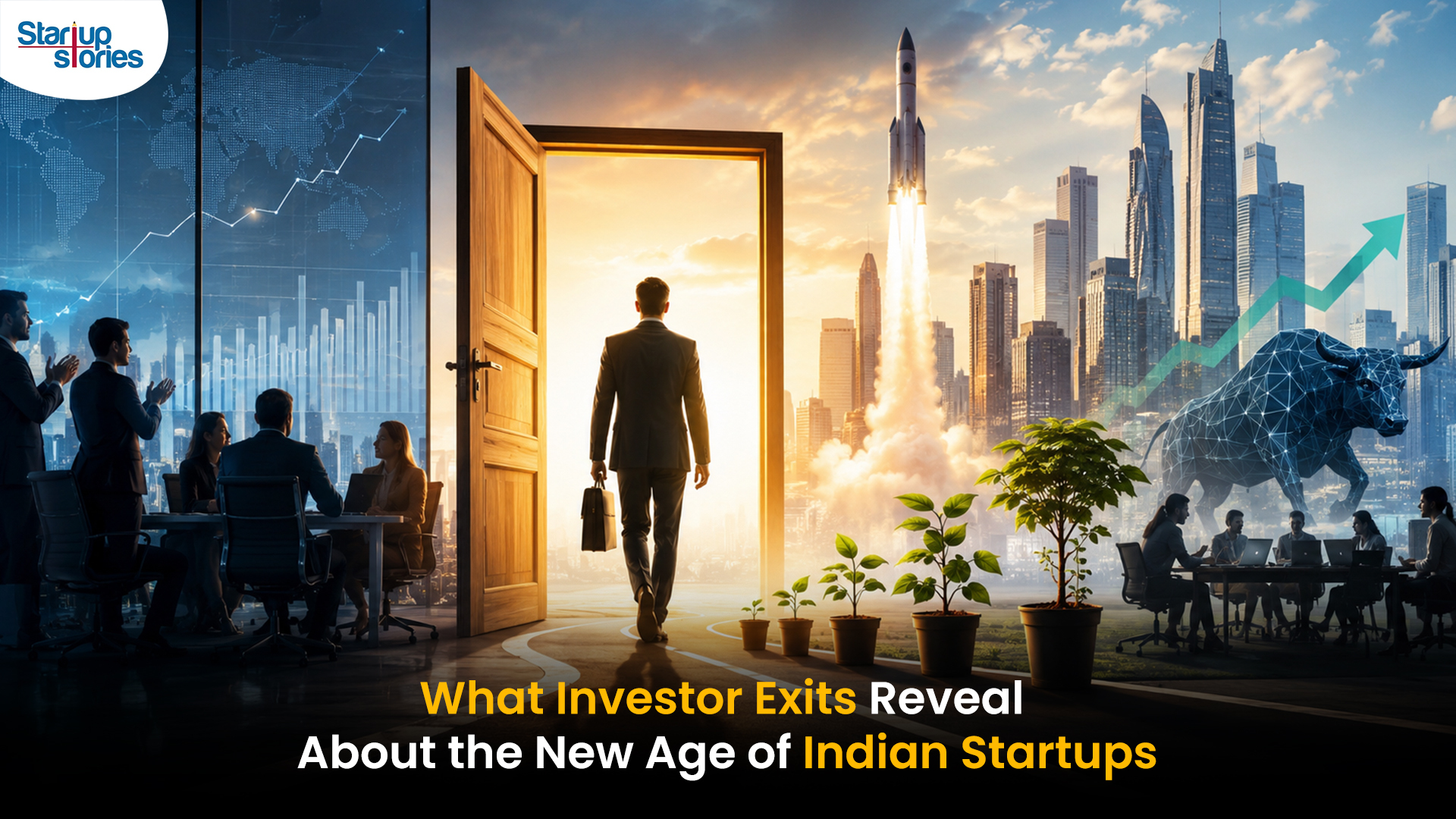
A decade ago, the success of a startup was measured largely by its ability to raise capital. Today, a different metric is gaining importance: the ability to generate meaningful exits for investors. Large stake sales by early backers are becoming increasingly common, not because growth opportunities have disappeared, but because India’s startup ecosystem is entering a more mature phase where capital is expected to complete its full cycle from investment to returns.
This evolution is particularly significant for consumer brands that have successfully blended technology, retail, and strong brand-building. Companies that were once viewed as high-risk startup bets are now attracting institutional investors capable of absorbing large transactions. Such developments indicate that these businesses are no longer being valued solely on future potential; they are increasingly being assessed on operational performance, market leadership, and long-term profitability. In many ways, investor exits are becoming a validation of a company’s ability to create lasting enterprise value.
The broader implication extends beyond a single company or investor. Successful exits encourage more global capital to enter India’s startup ecosystem because they demonstrate that liquidity opportunities exist at scale. As more venture-backed companies approach public listings, secondary transactions, or strategic investments, the focus of founders and investors alike may shift from chasing headline valuations to building durable businesses. The next chapter of India’s startup journey will likely be defined not just by the creation of unicorns, but by the creation of companies capable of delivering sustained returns to all stakeholders.

Common Governance Challenges Faced by Nonprofit Organizations in India

How Lenskart Made Indians Comfortable Buying Glasses Online


