
Entrepreneur Stories
AI Based Startups Currently Making A Splash


The year is 2019 and at the moment, there is one thing on every tech company’s mind—Artificial Intelligence (AI.) Startups all over the world are taking a leap with AI and Machine Learning (ML) as their wing bearers. From offering services like automated data collection to real time data collection, here are the best AI powered startups to watch out for this year:

1. Front
Although Front officially launched in the year 2014, it started making its presence felt only in the beginning of 2019. A completely user friendly tool, Front helps users stay connected to all the emails in your inbox, social media content and all your texts. By collating all the unread data in one place, this tool makes sure you don’t lose time by constantly switching between one app to another. The app is doing so well that CEO Mathilde Collin raised $ 66 million and made Front one of the hottest startups of this year!

2. Five AI
While the automotive industry has been dreaming about self driven cars for quite a while now, not a lot of companies have been able to turn this dream into reality. One of the major concerns about this field is, while the car can drive itself, will the car ensure the safety of the drivers and passengers as well? Five AI is a startup which is working on this very issue. Based out of Europe, this Company works on making sure all the cities in Europe have immersive and secure autonomous driving services. Five AI is planning to start trials with this service this year.

3. SenSat
Based out of Europe, SenSat is making massive waves by using AI. By building digital copies of physical environments, this Company uses artificial intelligence models to understand the parameters of the environment. By doing this, the startup aims at analysing and understanding the structure of the place so they can understand how much impact the project will have on the environment. To date, SenSat raised 3.4 million pounds in seed funding and has made a steady climb to the top in this field.

4. Toutiao
Founded in the year 2012, Toutiao is based out of China. A content platform, this startup helps people discover content all over the world by using artificial intelligence technology. Using the Natural Learning Process and Computer Vision tools, this Company extracts keywords and entities from individual pieces of content. In the beginning of this year, Toutiao joined Buzzfeed to distribute content to 120 million consumers in China!

5. Skydio
This startup combines two of the most exciting fields in technology: AI and drones. Based in San Francisco, this startup designs self flying camera drones which drive without any help from humans. Not only does it show and interpret things around it, it can also give visuals as seen in real time. One of the primary things on which this startup is working is making sure visuals are captured without obstacles. The AI powered drone can be remotely controlled from your smartphone.
About which startup are you most excited? Comment and let us know!









While there has been continuous growth in the Indian non-profit sector, many organizations have fallen behind on governance. A founder who completes Section 8 registration obtains a legal entity, a board, and a defined mission. However, operating that organization in a manner that will meet the expectations of the regulators, banks, and donors is the difficult part.
Government statistics tell the story of these regulatory lapses. According to the government data, there were 21,983 cancellations of NGOs over the last year, with 91.3% of the cancellations being due to failure to file annual returns. Active FCRA-registered NGOs also fell from 29,022 in 2015 to 14,466 as of September 2026.
Late Filings are the Main Reason NGO Registrations Get Cancelled
The cancellation statistics show that organizations mostly lose their registration because of the failure to file on time, and not because of anything of grave concern. Other legal violations resulted in only 0.4% of cancellations, and the rest are attributed solely to lapsed filings.
This is because small and volunteer groups often don’t have an accountant on staff, and no one is dedicated to checking for due dates. Therefore, a late return becomes a lost license a few cycles later.
Why Board Oversight Often Falls Short in Small Nonprofits?
While directors, minutes, and regular meetings are necessary for a Section 8 company, in practice many boards consist of the founder and two relatives or colleagues who sign anything placed before them. Informal decisions are made, and minutes are written afterwards to match. This continues until the bank, an auditor, or a CSR partner requests proof of expense approval.
If the board, no matter what its legal structure is, is unable to keep any log of its own decisions, it has a governance gap.
Section 8 Company Compliances That Often Get Missed
The statutory calendar is not long, but it carries strict deadlines. Section 8 company compliances include:
- At least one board meeting every six months, with minutes kept
- Annual AGM without exception
- A first-year statutory audit report
- Annual filings with the ROC and director KYC
- Income tax return in ITR-7 along with separate FCRA returns if foreign funds are received
Failure to take all of these into consideration results in penalties. In fact, for organizations holding an FCRA registration, failure to file the required returns can lead to suspension or cancellation of that registration under Section 13 of the FCRA, 2010.
What CSR Funders Expect from Nonprofit Financial Records?
Data from the MCA shows that CSR spend increased by 17% to reach a record ₹40,794 crore in FY 2024-25. This means that more corporate money is available to nonprofits than before. Usually, the corporate funders require a Darpan ID, Form CSR-1 filing, 12A and 80G registrations, and utilization certificates to grant capital.
When nonprofits combine project funds with general funds or cannot demonstrate that funds are being spent on a specific project, they generally fail to reap the benefits of this even if their programme work is good.
Why New FCRA Rules Add Pressure on Nonprofits?
The rules are also changing. On 22nd June, 2026, the government implemented changes in the Foreign Contribution (Regulation) Rules, introducing new compliance requirements for organizations receiving foreign funds. The proposed Foreign Contribution (Regulation) Amendment Bill, 2026, which was tabled in Parliament during the Monsoon Session, suggests the establishment of a Designated Authority that would assume foreign donations and assets created with foreign funds upon the termination of the registration. Organizations with poor records and no documented processes are the most susceptible to changes such as these.
Practical Steps Toward Stronger Nonprofit Governance
A compliance calendar that is owned by a named person, a board that meets and records minutes, an advance appointment of an auditor, and funding from more than one source mitigate most of the risks listed above. Registration creates the structure, but governance is what makes or breaks the organization’s ability to remain alive in five years.

In the past, purchasing eyewear in India was a highly regional activity. You entered a local optical store, selected a frame from a dusty wall, waited for someone to verify your power, and hoped the total cost wouldn’t be too exorbitant. There was little choice, little transparency, and little any justification for considering eyewear to be anything other than a medical necessity.That was altered by Lenskart.
Peyush Bansal, Amit Chaudhary, and Sumeet Kapahi founded Lenskart in 2010 in response to a question that many people disregarded: why was purchasing glasses still so difficult? Glasses are a personal item. People are concerned about the price, the quality of the lenses, and how the frames will seem on their faces. Because of this, selling eyewear online became challenging. In response, Lenskart did not make consumers pick between online and offline buying. It blended the two.
Before making a choice, customers may now browse frames online thanks to the company’s introduction of facilities like virtual try-on, home eye tests, and home trials. However, it also established physical locations where clients could obtain eye exams, try on frames, and get assistance from qualified personnel. This “online plus offline” strategy turned out to be one of its main advantages.
The more unexpected action took place in the background. Lenskart did not wish to rely just on local optical stores, importers, and overseas manufacturers. It started to have more control over the chain itself, including designing frames, manufacturing lenses, operating stores, and overseeing delivery. Lenskart benefited from what is known as vertical integration in three ways. First, by eliminating middlemen, it could maintain lower prices. Secondly, it might have closer control over quality. Third, as a frame style gained popularity, it could respond more quickly.In Bhiwadi, Rajasthan, Lenskart currently runs a sizable automated production facility capable of producing up to 50 million pairs of glasses a year. The company made 4 million lenses and 6.4 million frames internally in India in FY25.
In India, its expansion continued. Lenskart paid over $400 million to acquire the bulk of the Japanese eyewear company Owndays in 2022. Through the acquisition, Lenskart gained access to a number of Asian markets and gained knowledge from a more developed retail environment. Lenskart recorded operational revenue of ₹6,653 crore by FY25, a 22.6% increase over the previous year. However, Lenskart’s revenue isn’t what makes it intriguing. Glasses, a product that consumers often only purchase when they have a problem, were transformed into an inexpensive, technology-driven, design-driven shopping experience.
Due of its online frame sales, Lenskart lost. It prevailed because it eliminated the anxiety associated with purchasing eyewear online and then constructed stores for the times when clients still required human assistance.
The conclusion is straightforward: consumers don’t give a damn if a company operates online or offline. Convenience, assurance, and value are important to them. Businesses that integrate all three typically succeed.

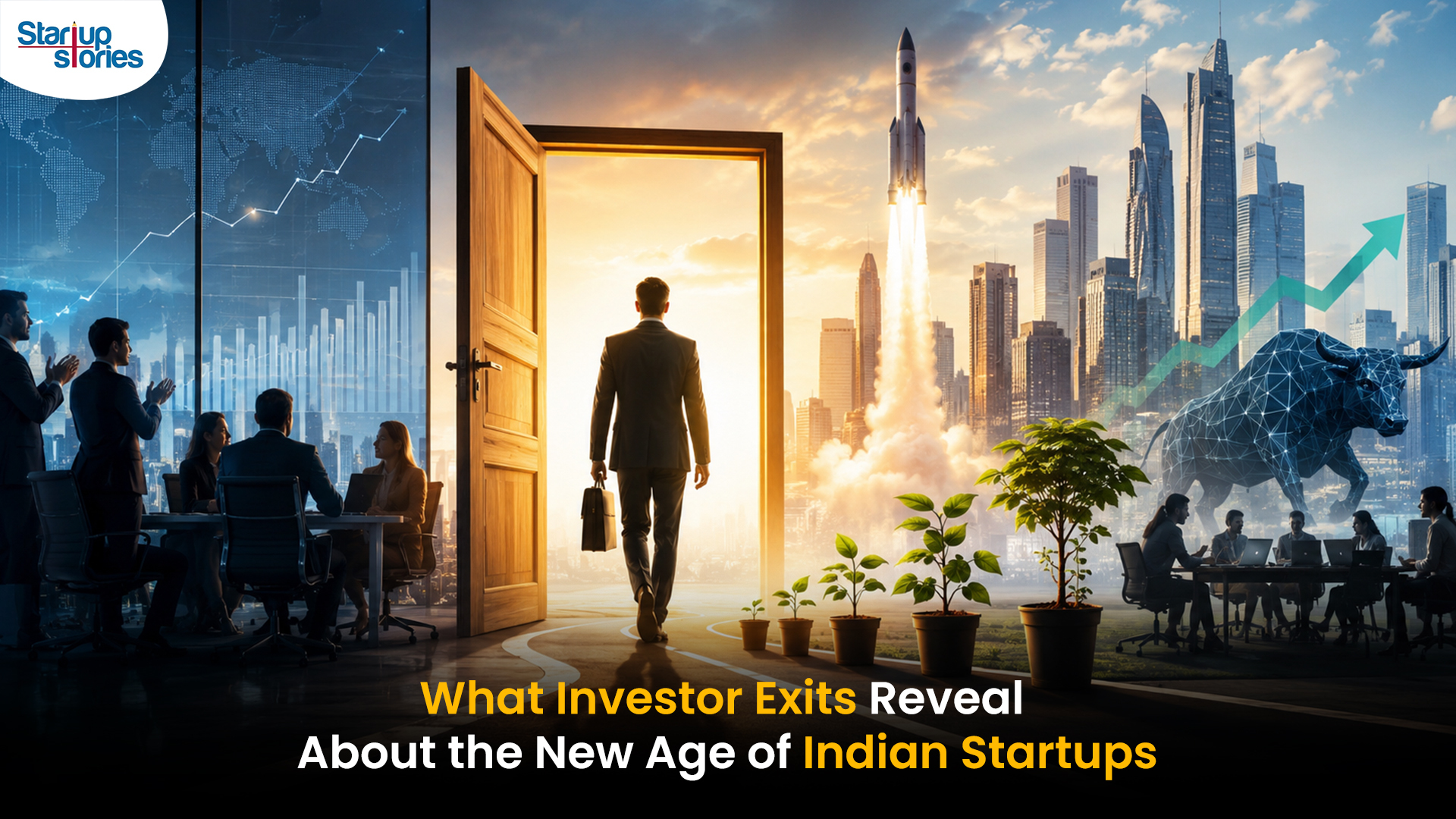
A decade ago, the success of a startup was measured largely by its ability to raise capital. Today, a different metric is gaining importance: the ability to generate meaningful exits for investors. Large stake sales by early backers are becoming increasingly common, not because growth opportunities have disappeared, but because India’s startup ecosystem is entering a more mature phase where capital is expected to complete its full cycle from investment to returns.
This evolution is particularly significant for consumer brands that have successfully blended technology, retail, and strong brand-building. Companies that were once viewed as high-risk startup bets are now attracting institutional investors capable of absorbing large transactions. Such developments indicate that these businesses are no longer being valued solely on future potential; they are increasingly being assessed on operational performance, market leadership, and long-term profitability. In many ways, investor exits are becoming a validation of a company’s ability to create lasting enterprise value.
The broader implication extends beyond a single company or investor. Successful exits encourage more global capital to enter India’s startup ecosystem because they demonstrate that liquidity opportunities exist at scale. As more venture-backed companies approach public listings, secondary transactions, or strategic investments, the focus of founders and investors alike may shift from chasing headline valuations to building durable businesses. The next chapter of India’s startup journey will likely be defined not just by the creation of unicorns, but by the creation of companies capable of delivering sustained returns to all stakeholders.

Common Governance Challenges Faced by Nonprofit Organizations in India

How Lenskart Made Indians Comfortable Buying Glasses Online


